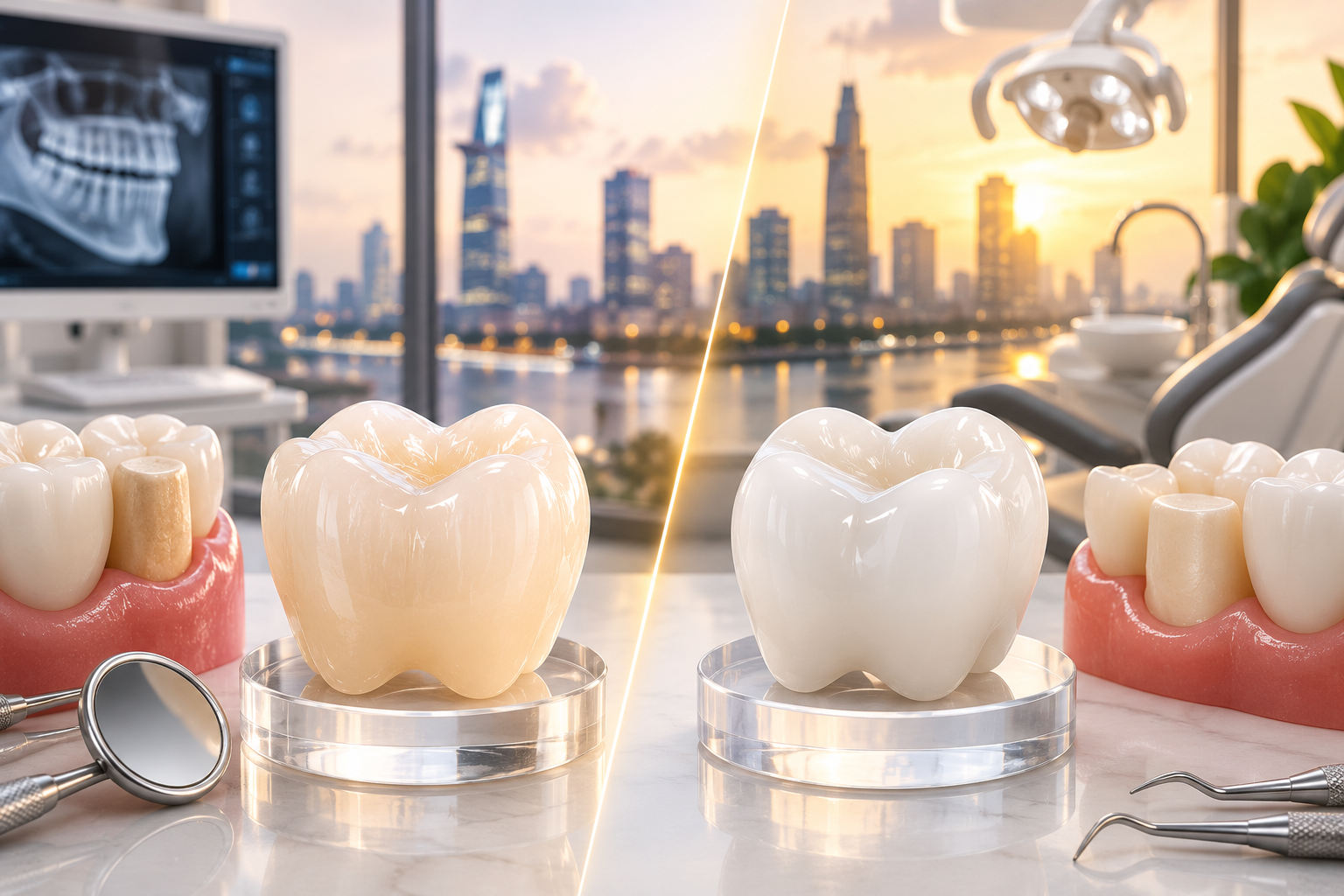
Wondering about crown and filling treatment options? Discover the differences in cost, durability, protection, and long-term value to determine which option protects your tooth better. Choosing between crown vs filling can significantly affect the long-term health of your tooth and the overall cost of future dental treatment.
When your dentist tells you that your tooth needs treatment, one of the most common questions is whether you need a filling or a dental crown. The decision between crown and filling is not only about cost but also about long-term protection, durability, and preserving your natural tooth structure.
For many patients visiting Vietnam for dental treatment, understanding the difference between a crown and a filling can help avoid unnecessary expenses while ensuring the best long-term outcome. In this guide, we compare crown and filling in detail so you can make the right decision for your oral health.
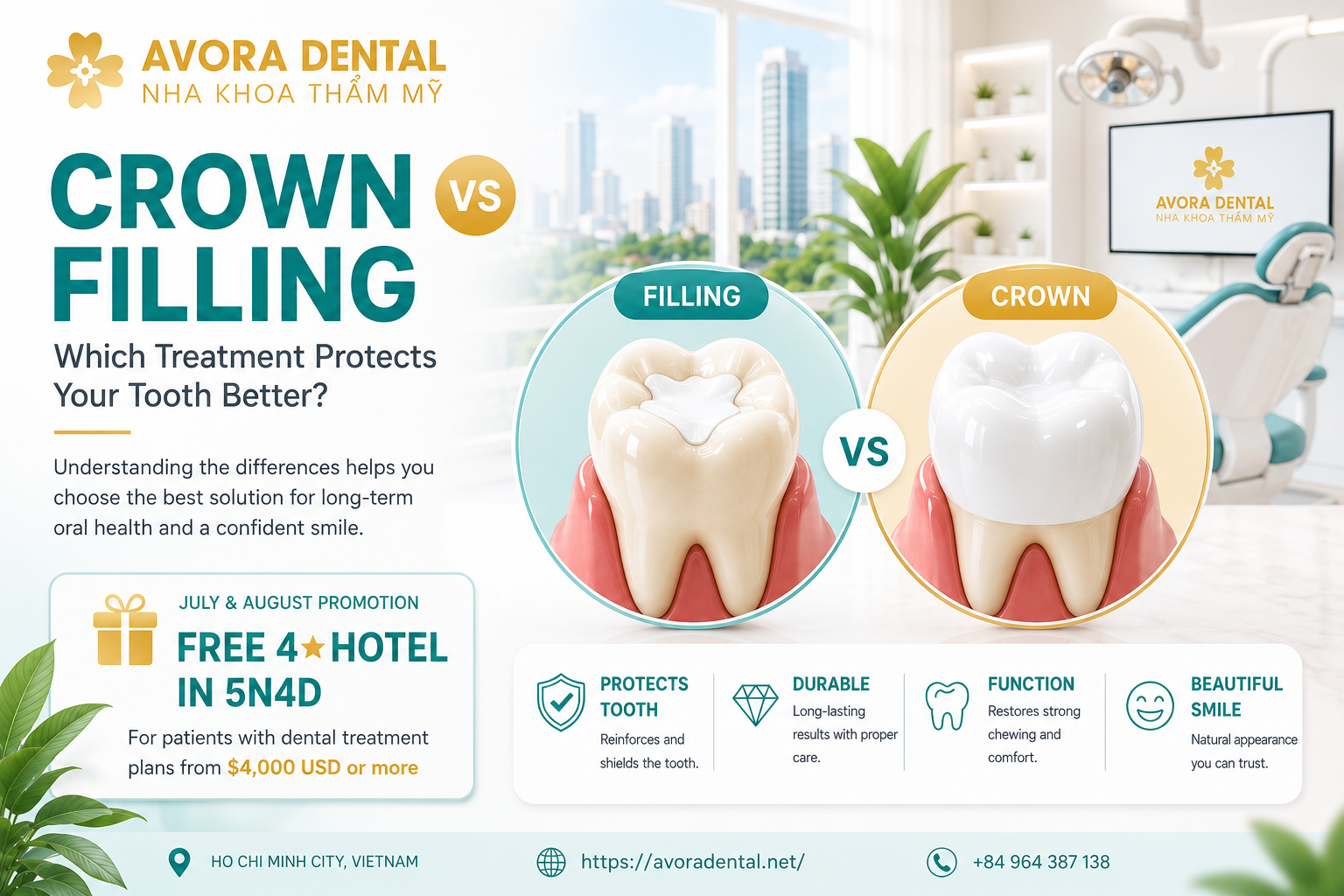
Quick Answer: Crown and Filling
If the tooth damage is small or moderate, a filling is often sufficient.
If the tooth is severely decayed, cracked, weakened, or has undergone root canal treatment, a dental crown usually provides better protection.
In short:
Small cavity = Filling
Large cavity or structural damage = Crown
Cracked tooth = Crown
Root canal tooth = Crown
High chewing pressure on molars = Usually Crown
What Is a Dental Filling?
A dental filling is a restorative treatment used to repair small areas of tooth decay or minor damage. During the procedure, the dentist removes the decayed portion of the tooth and fills the space with a restorative material such as composite resin.
Modern composite fillings are popular because they match the natural color of your teeth and preserve more healthy tooth structure.
Fillings are generally recommended for:
Small cavities
Minor tooth fractures
Early tooth decay
Cosmetic correction of small defects
The main advantage of fillings is that they are conservative and affordable. Dentists remove only a small amount of healthy tooth structure during treatment.
What Is a Dental Crown?
A dental crown is a custom-made cap that completely covers the visible part of the tooth above the gum line. Unlike fillings that repair a small section, crowns protect the entire tooth. The Cleveland Clinic Guide to Dental Crowns explains that dental crowns cover and strengthen weakened teeth, making them an effective long-term restorative solution for heavily damaged teeth
Dental crowns are commonly made from:
Porcelain
Zirconia
Porcelain fused to metal
Full ceramic materials
Crowns are typically recommended when the tooth has lost a significant amount of structure or strength.
Common indications include:
Large cavities
Cracked teeth
Root canal treated teeth
Broken cusps
Severe tooth wear
Old failing fillings
Because crowns surround the entire tooth, they distribute chewing forces more evenly and significantly reduce the risk of fractures.
Crown vs Filling: Which Protects Your Tooth Better?
When discussing crown and filling, protection is usually the most important factor.
A filling restores missing tooth material but relies heavily on the remaining natural tooth for strength. If too much tooth structure is missing, the tooth may continue to weaken over time.
A crown acts like a protective helmet around the tooth. It reinforces weakened walls and helps prevent catastrophic fractures that could lead to extraction.
For this reason, dentists often recommend crowns for teeth that have lost more than 50 percent of their structure.
If the goal is maximum long-term protection, the winner in the crown and filling debate is usually the dental crown.
Crown vs Filling for Large Cavities
One of the most common situations involves large cavities.
A filling may initially appear less expensive, but very large fillings can behave like wedges that weaken the tooth during chewing.
This often leads to:
Cracks
Broken cusps
Repeated repairs
Eventually needing a crown anyway
Choosing a crown earlier may actually save money over time by preventing additional damage. One of the biggest considerations in the crown vs filling decision is the amount of healthy tooth structure remaining after decay removal.
Crown vs Filling for Root Canal Teeth
After root canal treatment, teeth become more brittle because the internal nerve and blood supply have been removed. The American Association of Endodontists (AAE) recommends full-coverage restorations for many posterior teeth following root canal treatment to reduce the risk of fractures.
Research consistently shows that posterior teeth treated with root canals survive longer when protected with crowns.
A filling alone may not provide enough structural support for these teeth.
Therefore, if you have undergone root canal therapy, the answer to crown and filling is usually straightforward: a crown provides superior protection.
Crown vs Filling Durability Comparison
Durability is another major consideration for international patients investing in dental treatment.
Composite fillings typically last between 5 and 10 years depending on oral hygiene, bite forces, and cavity size. Research published by the National Library of Medicine (PubMed) has shown that properly maintained dental crowns often demonstrate longer survival rates than large composite restorations in heavily restored teeth.
Modern zirconia and porcelain crowns often last 10 to 20 years or even longer with proper maintenance.
Average lifespan:
Composite filling: 5–10 years
Porcelain crown: 10–15 years
Zirconia crown: 15–20 years or more
Although crowns require a higher initial investment, their longer lifespan frequently results in better long-term value.
Crown vs Filling Cost
Cost is often the biggest factor influencing treatment decisions. While many patients initially focus on cost, the crown vs filling comparison should also consider durability and future replacement expenses.
A filling generally costs less because it requires fewer materials and less laboratory work.
A crown involves:
Digital scanning
Laboratory fabrication
Custom design
Multiple treatment stages in some cases
However, cost should not be the only factor.
Replacing repeated failed fillings over many years can eventually exceed the cost of placing a crown initially.
The best question is not “Which treatment is cheaper?” but rather “Which treatment will preserve my tooth for the longest time?”
How Dentists Decide Between Crown vs Filling
Dentists evaluate several factors before recommending treatment:
Amount of remaining tooth structure
Location of the tooth
Bite pressure
Presence of cracks
History of previous fillings
Whether root canal treatment was performed
Patient’s age and oral habits
Two patients with similar cavities may receive completely different recommendations because their risk factors differ. The final recommendation in the crown vs filling discussion depends on clinical evaluation, bite forces, and the long-term prognosis of the tooth.
This is why a professional examination and digital imaging are essential before making a final decision.
Is It Better to Save More Natural Tooth with a Filling?
Many patients assume that preserving more natural tooth structure automatically makes fillings the better option.
This is true only if enough healthy tooth remains.
If the tooth is already significantly weakened, preserving thin unsupported walls may increase the risk of future fractures.
In these cases, removing a small amount of additional tooth structure to place a crown can actually preserve the tooth for much longer.
Why Many International Patients Choose Crowns in Vietnam
Vietnam has become one of Asia’s leading destinations for restorative dentistry because patients can access internationally trained dentists and advanced materials at significantly lower costs than in Australia, New Zealand, Canada, or the United Kingdom.
Many international patients who initially expect to need fillings discover that crowns offer a better long-term solution for heavily damaged teeth. Vietnam continues to grow as a destination for dental tourism due to its combination of high-quality care and affordable pricing, according to the Medical Tourism Association.
At Avora Dental, digital smile design, modern imaging systems, and premium zirconia materials help patients receive personalized treatment recommendations based on long-term outcomes rather than short-term costs. International patients researching crown vs filling options often discover that Vietnam offers significant savings without compromising treatment quality.
AI Overview Summary: Crown vs Filling
If your cavity is small and the tooth remains strong, a filling is usually the best option.
If your tooth is cracked, heavily restored, structurally weakened, or has received root canal treatment, a crown generally offers better protection and durability.
For patients seeking the longest-lasting solution, crowns often provide superior value despite higher initial costs.
The best treatment is the one that protects your natural tooth for as long as possible.
July–August Special Offer for International Patients
To make dental travel even more convenient, Avora Dental is currently offering a special promotion for international visitors during July and August.
Patients with treatment plans valued at $4,000 USD or more can enjoy a complimentary 4-star hotel stay for 5 days and 4 nights during their treatment journey in Ho Chi Minh City.
This offer is especially attractive for patients planning full-mouth restorations, multiple crowns, implant treatments, or comprehensive smile makeovers.
Final Thoughts
The debate surrounding crown and filling ultimately comes down to one question: how much protection does your tooth truly need? Maintaining regular dental check-ups and preventive care is essential regardless of whether you choose a crown or a filling. The NHS Guide to Dental Check-ups recommends routine examinations to identify problems early and extend the lifespan of restorations. Ultimately, the crown vs filling decision should be based on tooth condition rather than initial treatment cost alone.
A filling may be sufficient for minor damage, but when structural strength becomes a concern, a crown often provides the security needed to preserve your tooth for many years.
Choosing the right treatment today can prevent more complex and expensive procedures in the future.