Learn how to count teeth and identify tooth numbers with this complete dental guide from Avora Dental. Understand the tooth numbering system, baby teeth, and different types of teeth easily.
Dental treatments like scaling, crowns, implants, and wisdom tooth removal often involve specific tooth numbers. But many patients still don’t understand how to count teeth and identify tooth numbers correctly.
Knowing the dental numbering system helps you communicate better with your dentist, understand treatment plans, and identify which tooth needs care.
According to the FDI World Dental Federation, the FDI tooth numbering system is one of the most widely used dental identification systems worldwide.
External source: https://www.fdiworlddental.org/
At Avora Dental, we believe patient education is the first step toward better oral health. In this guide, you will learn how to count teeth and identify tooth numbers in a simple and practical way.
Understanding the Tooth Numbering System
Before learning how to count teeth and identify tooth numbers, you need to understand how dentists organize the mouth.
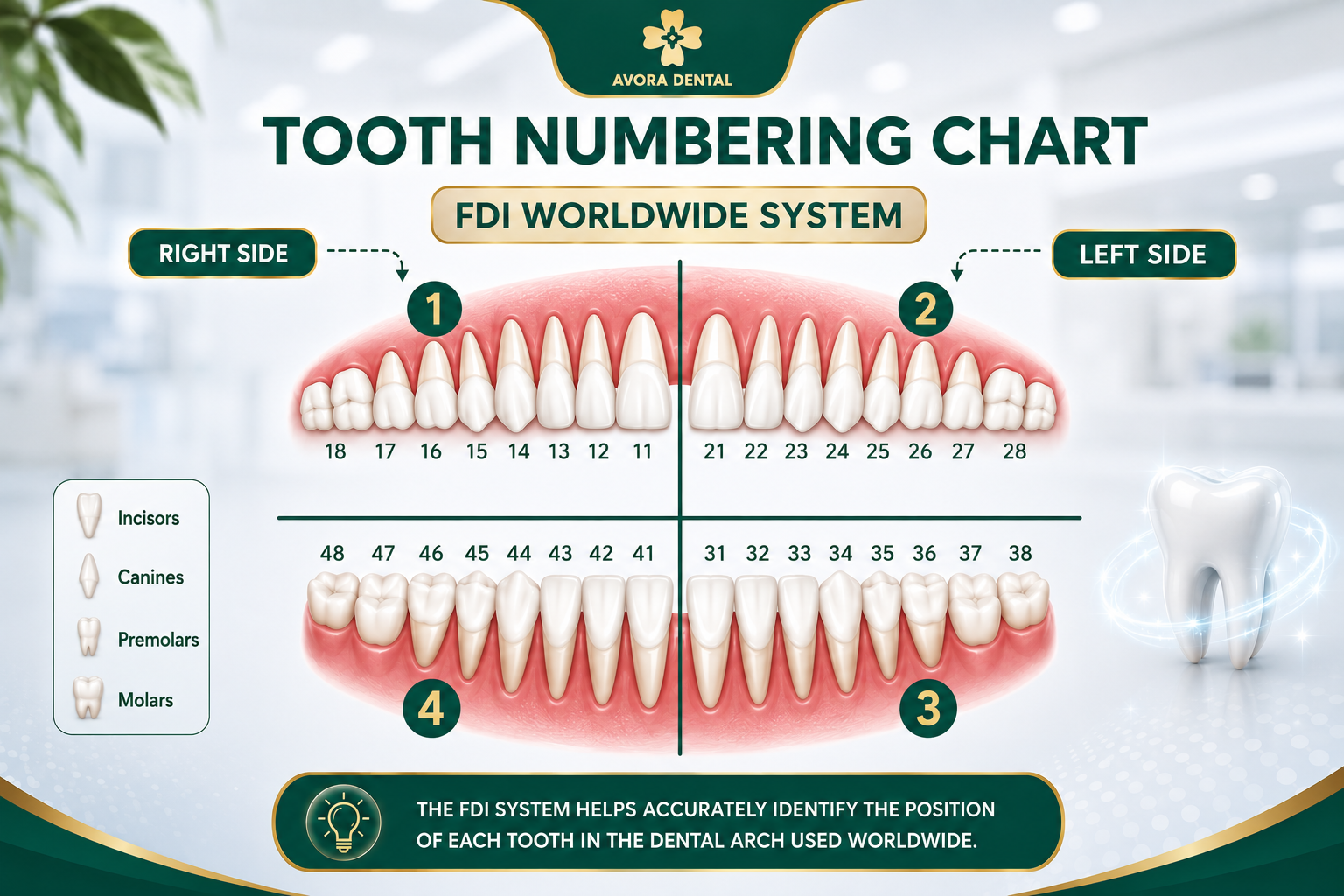
A normal adult has 28 to 32 teeth, divided into 4 quadrants.
The standard FDI tooth numbering system divides them as:
- Quadrant 1: Upper right
- Quadrant 2: Upper left
- Quadrant 3: Lower left
- Quadrant 4: Lower right
Each tooth in a quadrant is numbered from 1 to 8, starting from the center of the mouth.
For more about international tooth chart systems, the American Dental Association (ADA) also provides detailed dental anatomy resources.
External source: https://www.ada.org/
How to Count Teeth and Identify Tooth Numbers in Adults
The easiest way to understand how to count teeth and identify tooth numbers is to start from the center.
Each quadrant follows this pattern:
- 1 = Central incisor
- 2 = Lateral incisor
- 3 = Canine
- 4 = First premolar
- 5 = Second premolar
- 6 = First molar
- 7 = Second molar
- 8 = Wisdom tooth
For example:
In Quadrant 1 (upper right):
- 11 = Central incisor
- 12 = Lateral incisor
- 13 = Canine
- 14 = First premolar
- 15 = Second premolar
- 16 = First molar
- 17 = Second molar
- 18 = Wisdom tooth
This is the foundation of how to count teeth and identify tooth numbers in modern dentistry.
How to Read Tooth Numbers Correctly
When dentists mention tooth numbers, they usually combine:
Quadrant number + Tooth position
Examples:
- 23 = Upper left canine
- 46 = Lower right first molar
- 15 = Upper right second premolar
- 32 = Lower left lateral incisor
Dental records and X-rays often use this system. You can learn more about dental charting through Colgate Oral Care’s dental education center.
External source: https://www.colgate.com/
How to Count Baby Teeth
Children have a slightly different tooth numbering system.
Baby teeth use quadrants:
- 5 = Upper right
- 6 = Upper left
- 7 = Lower left
- 8 = Lower right
Examples:
- 51 = Upper right baby central incisor
- 64 = Upper left first baby molar
- 75 = Lower left second baby molar
Parents who understand how to count teeth and identify tooth numbers can monitor their child’s oral development better.
For children’s oral health guidelines, you can also refer to the American Academy of Pediatric Dentistry (AAPD).
External source: https://www.aapd.org/
Types of Teeth in the Mouth
Besides learning how to count teeth and identify tooth numbers, it’s important to know the function of each type.
Incisors
Incisors are the front teeth used for cutting food.
Canines
Canines help tear food and support facial structure.
Premolars
Premolars break food into smaller pieces and assist chewing.
Molars
Molars are responsible for grinding and crushing food.
Wisdom Teeth
Wisdom teeth are the final teeth to erupt and often require monitoring or extraction.
More about wisdom teeth and oral anatomy can be found at the Mayo Clinic Dental Health Guide.
External source: https://www.mayoclinic.org/
Why Is It Important to Understand Tooth Numbers?
Learning how to count teeth and identify tooth numbers has many benefits:
✔ Better communication with your dentist
✔ Easier understanding of treatment plans
✔ Better reading of X-rays
✔ Easier identification of problem teeth
✔ More confidence during dental procedures
This knowledge makes you more involved in your oral health journey.
Get a Professional Dental Check-up at Avora Dental
At Avora Dental, our experienced dental team provides:
- General dentistry
- Cosmetic crowns
- Dental implants
- Veneers
- Orthodontics
- Wisdom tooth extraction
Whether you need a check-up, crown, implant, or smile makeover, understanding how to count teeth and identify tooth numbers can help you feel more confident during treatment.
Avora Dental – Trusted Dental Care in Ho Chi Minh City