Losing multiple teeth can significantly affect your confidence, oral health, and quality of life. Fortunately, modern implant dentistry offers effective solutions for restoring a complete smile. Among the most popular full-mouth restoration options are all-on-4 vs all-on-6 dental implants.
However, when comparing all on 4 vs all on 6, many patients wonder which treatment offers better stability, durability, comfort, and long-term value.
Both procedures use strategically positioned dental implants to support a fixed full-arch prosthesis. Although they share the same fundamental goal, they differ in the number of implants, treatment planning, potential costs, and suitability for individual patients.
At Avora Dental, we understand that choosing a full-mouth dental implant solution is an important decision, especially for international patients considering dental treatment in Vietnam.
This comprehensive guide explores the differences between all on 4 vs all on 6, helping you understand the benefits, limitations, costs, and factors that may influence your treatment choice.
1. What Are All-on-4 Dental Implants?
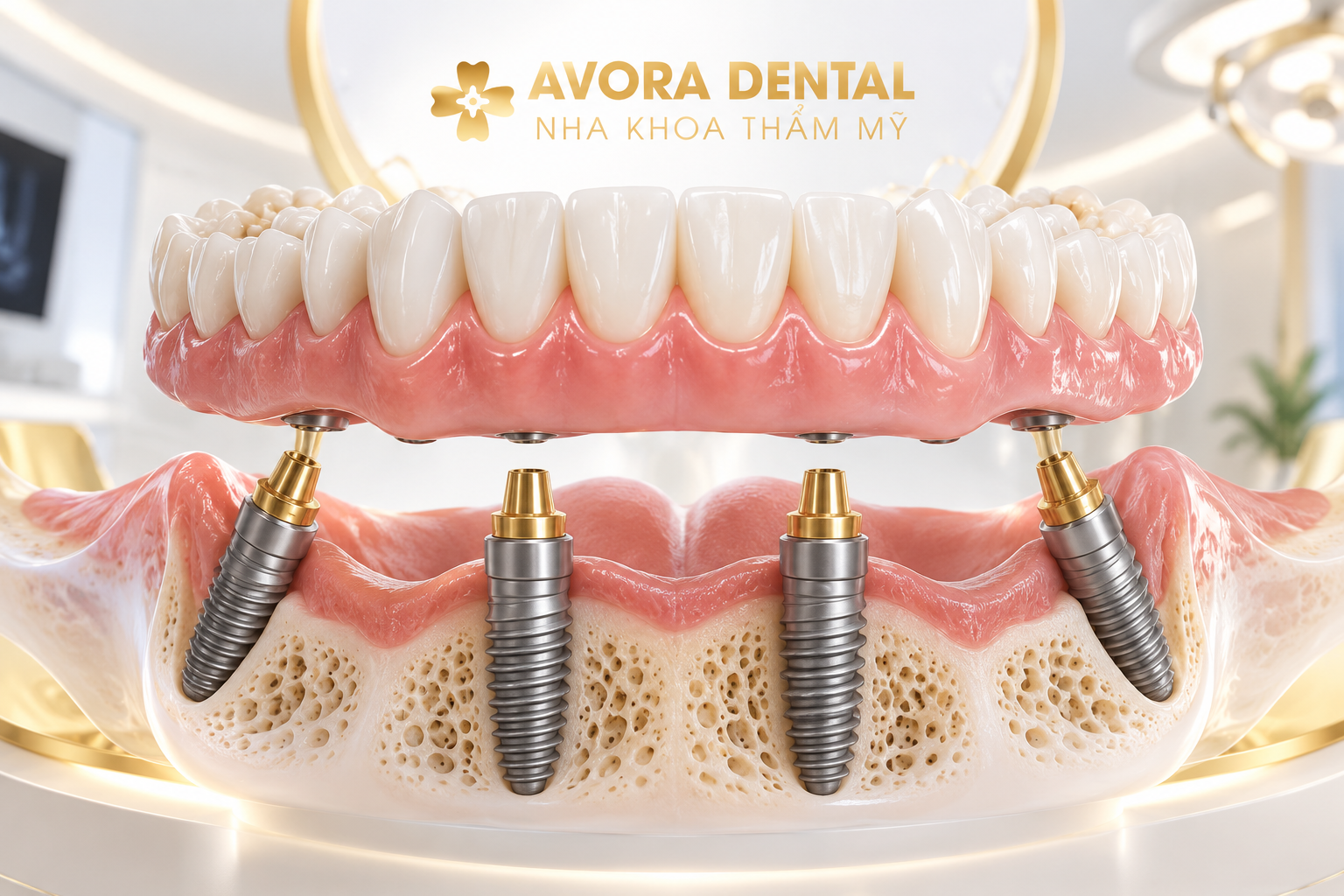
All-on-4 dental implants are a full-arch tooth replacement technique that uses four dental implants to support a fixed dental prosthesis.
Instead of replacing each missing tooth with an individual implant, this approach uses four carefully positioned implants to support an entire arch of artificial teeth.
Typically, two implants are placed toward the front of the jaw, while two posterior implants may be angled to maximize available bone support.
How Does All-on-4 Work?
The All-on-4 procedure generally involves several stages:
- Initial consultation: A dentist evaluates your oral health, medical history, and treatment goals.
- Diagnostic imaging: Dental X-rays and, when indicated, CBCT scans help assess bone anatomy and implant placement.
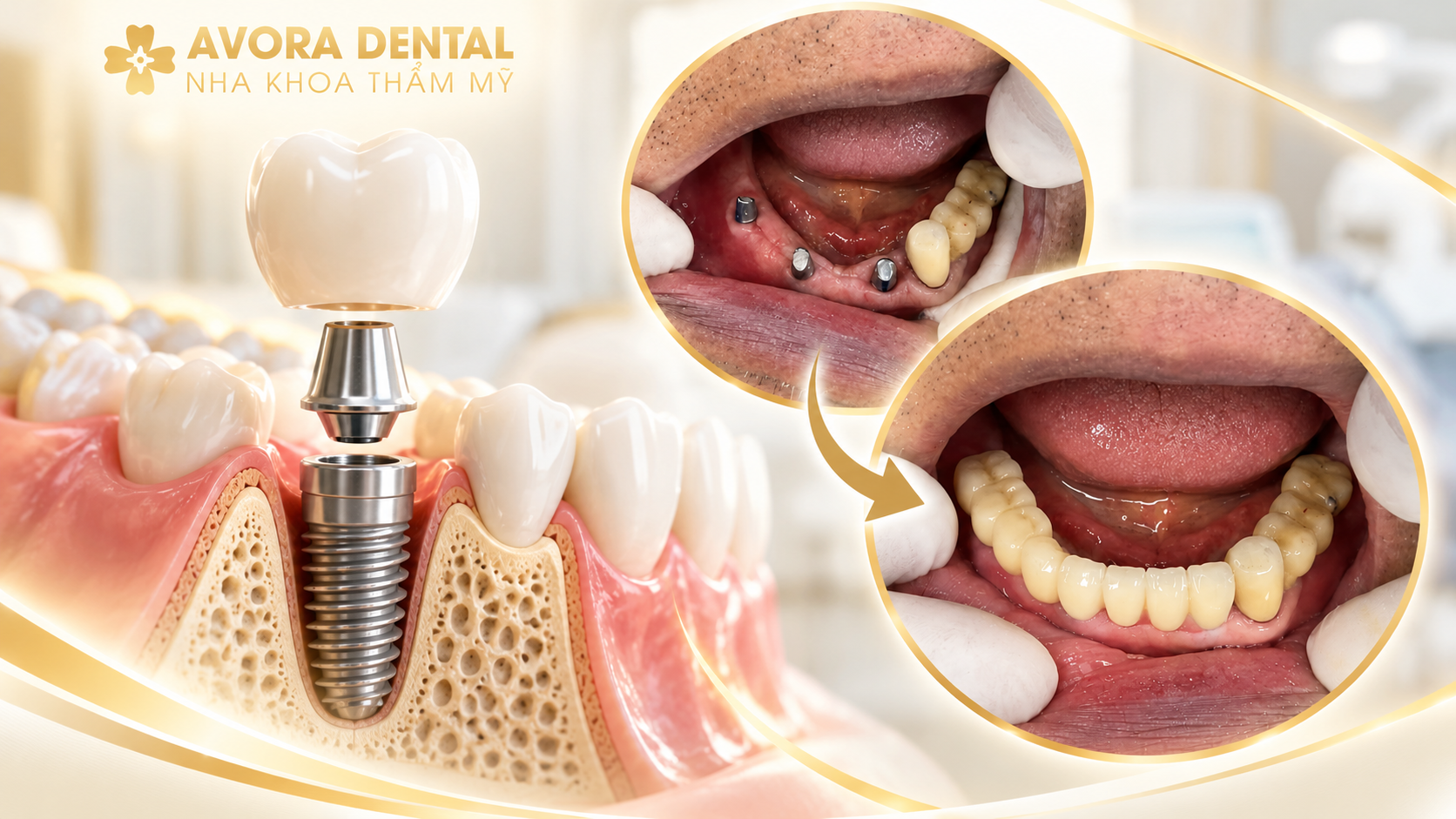
- Implant placement: Four implants are surgically inserted into the jawbone.
- Temporary restoration: Eligible patients may receive a fixed provisional prosthesis shortly after surgery.
- Healing period: The implants integrate with the surrounding jawbone over several months.
- Final restoration: A custom-designed permanent prosthesis is fitted once healing and implant stability are confirmed.
The treatment timeline varies depending on bone quality, implant stability, healing, and whether additional procedures are necessary.
Advantages of All-on-4 Dental Implants
All-on-4 offers several potential benefits:
- Uses four implants to support a complete dental arch.
- May reduce the need for bone grafting in selected patients.
- Can provide a fixed alternative to removable dentures.
- May involve lower implant-related costs than a six-implant approach.
- Can allow eligible patients to receive a temporary fixed restoration soon after surgery.
- Helps restore chewing function and smile aesthetics.
Limitations of All-on-4
Despite its advantages, All-on-4 is not suitable for every patient.
Potential limitations include:
- Greater reliance on each individual implant for prosthetic support.
- Possible complications if an implant fails.
- Anatomical or bone-related limitations that may affect treatment suitability.
- The need for careful prosthetic design and long-term maintenance.
When evaluating all on 4 vs all on 6, understanding these limitations is essential.
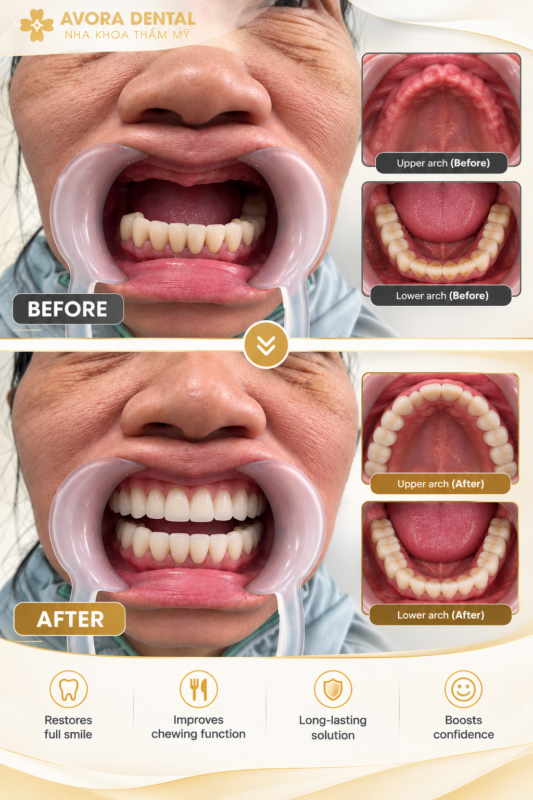
2. What Are All-on-6 Dental Implants?
All-on-6 dental implants are another full-arch restoration technique, using six implants to support a fixed dental prosthesis.
Compared with All-on-4, this method uses two additional implants, potentially allowing the prosthetic load to be distributed across more support points.
However, using more implants does not automatically guarantee better clinical outcomes.
The success of All-on-6 depends on factors such as implant positioning, bone quality, prosthetic design, oral hygiene, and overall patient health.
How Does All-on-6 Work?
The All-on-6 procedure typically follows a similar treatment process:
- Comprehensive dental consultation and examination.
- Diagnostic imaging and treatment planning.
- Placement of six dental implants.
- Temporary restoration when clinically appropriate.
- Healing and osseointegration.
- Placement of the final fixed dental prosthesis.
Patients must have sufficient suitable bone for the planned implant positions, or additional procedures may be required.
Advantages of All-on-6 Dental Implants
Potential benefits include:
- Six implants supporting a full dental arch.
- Additional implant support points.
- Potentially improved distribution of chewing forces in appropriately designed restorations.
- Flexibility in prosthetic planning for selected patients.
- A fixed solution for extensive tooth loss.
Limitations of All-on-6
All-on-6 may also present certain disadvantages:
- Higher costs associated with additional implants.
- More implant placement sites.
- Possible need for additional bone augmentation.
- Greater treatment complexity in some cases.
- Not necessarily better than All-on-4 for every patient.
The choice between all on 4 vs all on 6 should therefore be based on clinical needs rather than implant numbers alone.
3. All on 4 vs All on 6: Key Differences Explained
Understanding the differences between these two implant techniques is essential when choosing a full-mouth restoration.
The following comparison highlights the most important factors.
| Features | All-on-4 | All-on-6 |
|---|---|---|
| Number of implants | 4 per arch | 6 per arch |
| Treatment purpose | Full-arch tooth replacement | Full-arch tooth replacement |
| Implant support | Four support points | Six support points |
| Bone requirements | May suit selected patients with reduced posterior bone | Requires suitable bone at six planned implant sites |
| Bone grafting | May be avoidable in selected cases | May be necessary depending on anatomy |
| Treatment cost | Often lower | Often higher |
| Surgery | Four implant placements | Six implant placements |
| Temporary teeth | Possible for eligible patients | Possible for eligible patients |
| Long-term success | Depends on patient and treatment factors | Depends on patient and treatment factors |
| Maintenance | Essential | Essential |
Which Option Provides Better Stability?
One of the most common questions about all on 4 vs all on 6 concerns stability.
All-on-6 provides two additional implant support points, which may offer biomechanical advantages in certain prosthetic designs.
However, the relationship between implant number and clinical performance is complex.
Four properly positioned implants can provide sufficient support for a full-arch restoration in appropriately selected patients.
Factors influencing stability include:
- Implant position and angulation.
- Bone density and volume.
- Implant dimensions.
- Prosthetic material and design.
- Bite forces and occlusion.
- Bruxism or teeth grinding.
- Overall oral health.
Therefore, All-on-6 should not automatically be considered more stable or successful in every situation.
4. All on 4 vs All on 6 Cost: Which Is More Affordable?
Cost is an important consideration for patients exploring full-mouth dental implants.
When comparing all on 4 vs all on 6 cost, All-on-4 is generally less expensive because it requires fewer implants.
However, the final treatment price depends on several factors.
Factors Affecting Dental Implant Costs
Number of implants
All-on-6 requires six implants per arch, while All-on-4 uses four.
Additional implants can increase the cost of implant components and surgery.
Implant brand
Different implant systems have different prices, clinical histories, and component costs.
Prosthetic materials
The final restoration may be manufactured using materials such as zirconia, acrylic-based prosthetic systems, or other clinically appropriate materials.
Bone grafting
Some patients require bone augmentation before or during implant treatment.
Additional procedures
Tooth extractions, periodontal treatment, sedation, and other services may affect the final cost.
Clinic location
Dental implant treatment prices vary between countries, cities, and dental providers.
Why Consider Dental Implants in Vietnam?
Vietnam has become an option for international patients exploring dental treatment abroad.
Potential advantages include:
- Competitive treatment pricing compared with some higher-cost countries.
- Access to modern dental technology at selected clinics.
- Opportunities to combine dental appointments with travel.
- Availability of clinics serving international patients.
However, patients should evaluate qualifications, infection-control standards, implant systems, follow-up arrangements, and total treatment costs rather than choosing a clinic based on price alone.
At Avora Dental, patients considering full-mouth restoration can request an individualized consultation to discuss suitable treatment options and estimated costs.
Important: An accurate All-on-4 or All-on-6 quotation requires clinical assessment. Patients should confirm whether the proposed package includes diagnostic imaging, surgery, temporary teeth, final restorations, medications, and follow-up care.
5. All on 4 vs All on 6: Which Procedure Is More Comfortable?
Patient comfort is another important factor when comparing all on 4 vs all on 6.
Both treatments involve implant surgery and may cause temporary discomfort, swelling, bruising, or tenderness.
The amount of postoperative discomfort varies depending on the complexity of surgery, the patient’s health, and any additional procedures.
Comfort During Surgery
Both procedures are commonly performed using local anesthesia. Sedation may also be considered when clinically appropriate.
Although All-on-6 involves two additional implants, this does not necessarily mean that patients will experience substantially more discomfort.
Comfort After Surgery
Patients may experience:
- Mild to moderate swelling.
- Temporary gum tenderness.
- Minor bruising.
- Difficulty chewing harder foods during early healing.
- Temporary changes in speech while adapting to a new prosthesis.
Dentists provide postoperative instructions to help manage discomfort and protect the healing implants.
6. All on 4 vs All on 6 Recovery Time
Many international patients want to know how long they need to remain in Vietnam after implant surgery.
When comparing all on 4 vs all on 6 recovery, the healing process is generally similar.
First 24–72 Hours
Patients may experience swelling, tenderness, and minor bleeding.
Rest, prescribed medication, and careful oral hygiene are important during this period.
First 1–2 Weeks
Initial soft-tissue healing takes place.
Swelling and discomfort usually decrease, although individual recovery times vary.
Patients should follow their dentist’s instructions regarding diet, cleaning, and physical activity.
Following Months
Osseointegration occurs as the jawbone heals around the implants.
This process often takes several months and may vary depending on bone quality, surgical conditions, and patient health.
Final Restoration
The final prosthesis is typically fitted once the dentist confirms that the implants have achieved sufficient healing and stability.
Important for international patients: Receiving temporary fixed teeth shortly after surgery does not mean the implants have fully healed.
Patients should discuss the number of required visits, travel restrictions, and follow-up appointments before arranging their trip.
7. All on 4 vs All on 6: Which Lasts Longer?
Longevity is a major concern for patients investing in full-mouth dental implants.
Both All-on-4 and All-on-6 can provide long-term tooth replacement when properly planned, maintained, and monitored.
However, neither treatment guarantees lifelong success.
What Affects Implant Longevity?
Several factors influence long-term outcomes:
Oral hygiene
Patients must clean around their implants and prosthetic restoration regularly.
Gum health
Inflammation and infection around implants can threaten long-term implant stability.
Smoking
Smoking is associated with increased risks of implant-related complications.
Medical conditions
Certain health conditions and medications may affect healing or implant maintenance.
Bite forces
Excessive chewing forces or untreated teeth grinding can increase mechanical complications.
Regular dental visits
Professional examinations help identify potential problems early.
Does All-on-6 Last Longer Than All-on-4?
There is no universal clinical rule that All-on-6 lasts longer simply because it uses more implants.
Research suggests that full-arch restorations supported by four implants can achieve favorable outcomes in appropriately selected patients.
However, study findings vary, and individual treatment recommendations should consider the available evidence and patient-specific clinical conditions.
For additional information about dental implants, visit the American Academy of Periodontology.
8. Who Is a Good Candidate for All-on-4?
All-on-4 may be considered for patients who:
- Have lost most or all teeth in one dental arch.
- Have severely damaged teeth that cannot be predictably restored.
- Want a fixed alternative to removable dentures.
- Have suitable bone anatomy for four strategically positioned implants.
- Prefer a treatment plan involving fewer implants when clinically appropriate.
Some patients with reduced posterior jawbone volume may be candidates for All-on-4 because angled implants can sometimes avoid anatomical structures and reduce the need for bone grafting.
However, eligibility must be determined through a comprehensive dental examination.
9. Who Is a Good Candidate for All-on-6?
All-on-6 may be considered for patients who:
- Need complete upper- or lower-arch rehabilitation.
- Have sufficient bone at six planned implant positions.
- May benefit from additional implant support.
- Have prosthetic requirements that favor a six-implant design.
- Are comfortable with the potentially higher treatment cost.
The suitability of All-on-6 depends on individual anatomy and the dentist’s treatment plan.
Patients should not assume that receiving more implants automatically means receiving better treatment.
10. All on 4 vs All on 6: Which Is Better for International Patients?
For international patients, choosing between all on 4 vs all on 6 involves more than comparing clinical features.
Travel arrangements, treatment schedules, postoperative care, and communication with the dental team are also important.
Consider Your Treatment Timeline
Some patients may require multiple visits separated by several months.
Ask your dentist whether your treatment can be completed in one trip or requires a return visit.
Understand the Total Treatment Cost
Request a detailed quotation covering:
- Implant surgery.
- Implant components.
- Temporary prosthesis.
- Final prosthesis.
- Diagnostic imaging.
- Additional procedures.
- Follow-up appointments.
Plan for Follow-Up Care
Patients should understand how postoperative complications will be managed after returning home.
Regular maintenance is essential regardless of whether they choose All-on-4 or All-on-6.
Choose a Qualified Dental Provider
A full-mouth implant procedure requires careful diagnosis, surgical planning, prosthetic expertise, and ongoing care.
When considering treatment abroad, patients should ask about the treating dentist’s qualifications, experience, and approach to long-term maintenance.
11. Why Consider Avora Dental for Full-Mouth Implant Consultation in Vietnam?
Choosing the right dental clinic is just as important as selecting the appropriate implant technique.
At Avora Dental, we understand that international patients need clear information before making decisions about complex dental treatments.
Patients considering full-mouth dental restoration can begin by discussing their oral health concerns, treatment expectations, and preferred travel schedule.
Personalized Treatment Assessment
The choice between All-on-4 and All-on-6 should be based on a thorough clinical evaluation.
Important considerations include:
- Current oral health.
- Available jawbone.
- Number and condition of remaining teeth.
- Medical history.
- Functional and aesthetic expectations.
- Financial considerations.
Clear Treatment Planning
Patients should receive an explanation of the recommended procedure, expected timeline, potential risks, and available alternatives.
Support for International Patients
Patients traveling to Vietnam should discuss appointment scheduling, required treatment stages, and follow-up care before confirming travel arrangements.
The goal is to help each patient make an informed decision based on their clinical needs.
12. Frequently Asked Questions About All on 4 vs All on 6
Is All-on-6 Better Than All-on-4?
Not necessarily.
All-on-6 provides additional implant support points, but All-on-4 can be an effective solution for appropriately selected patients.
The best option depends on bone anatomy, prosthetic requirements, oral health, and treatment goals.
Is All-on-4 Cheaper Than All-on-6?
Generally, yes.
All-on-4 often costs less because it requires fewer implants.
However, the total treatment price also depends on implant brands, prosthetic materials, additional procedures, and clinic pricing.
Is All-on-6 More Painful Than All-on-4?
Not necessarily.
Both procedures involve implant surgery, and postoperative discomfort varies between patients.
The number of implants alone does not determine the level of pain.
Can All-on-4 or All-on-6 Be Completed in One Day?
Eligible patients may receive a temporary fixed prosthesis on the day of surgery or shortly afterward.
However, the final restoration usually requires additional healing time and follow-up appointments.
Which Is Better for Patients With Bone Loss?
All-on-4 may be suitable for some patients with reduced posterior bone volume because of its implant positioning strategy.
However, severe bone loss may require other approaches, and neither technique is automatically suitable.
Can I Eat Normally With All-on-4 or All-on-6?
After successful healing and adaptation, many patients can eat a wide variety of foods.
However, patients generally need to follow a modified diet during early healing to avoid excessive pressure on the implants.
How Do I Choose Between All-on-4 and All-on-6?
The most reliable approach is to undergo a comprehensive examination and discuss your options with an appropriately qualified implant dentist.
Diagnostic imaging, bone assessment, medical history, and prosthetic planning help determine the most suitable treatment.
13. Final Verdict: All on 4 vs All on 6 – Which Should You Choose?
When comparing all on 4 vs all on 6, there is no single treatment that is universally better for every patient.
All-on-4 may be a suitable choice for patients who need full-arch rehabilitation with four strategically positioned implants and want to explore a potentially more cost-effective treatment option.
All-on-6 may be appropriate for patients whose anatomy and prosthetic requirements support the use of six implants.
Both methods can provide functional and aesthetic benefits when treatment is carefully planned and maintained.
Ultimately, the best choice depends on your individual oral health, jawbone condition, treatment goals, and professional clinical assessment.
Start Your Full-Mouth Dental Implant Journey With Avora Dental
Are you considering full-mouth dental implants in Vietnam but unsure which procedure is right for you?
Avora Dental can help you begin exploring your treatment options.
Whether you are interested in All-on-4 or All-on-6, understanding the differences is the first step toward making an informed decision.
Contact Avora Dental to arrange a consultation and discuss the most appropriate full-mouth restoration options for your needs.
Your journey toward a healthier, more confident smile begins with the right information and a personalized treatment plan.